Learn the Role
& Study
A public adjuster represents the insured, not the insurance company, on first-party property claims. Study property loss adjusting, policy forms, valuation concepts and New Jersey public adjuster law.
A step-by-step guide to the exam, fingerprints, bond, fees and renewal.
To become a public adjuster in New Jersey, you pass the PSI licensing exam, complete fingerprinting if you are a resident, secure a $10,000 surety bond, and submit your application to NJDOBI with the $70 license fee.
Updated November 25, 2026. Based on current NJDOBI, PSI and NIPR information.
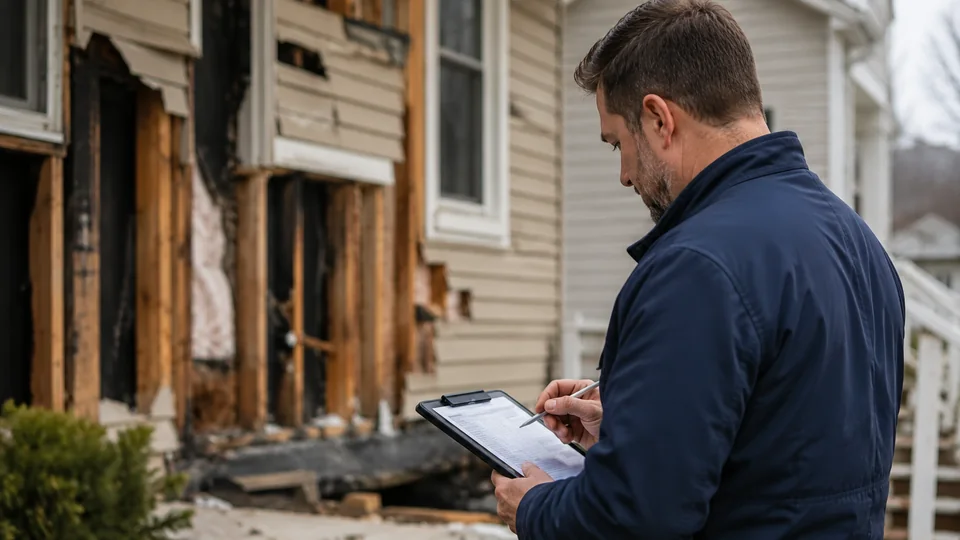
New Jersey licenses public adjusters under a separate act from insurance producers. These are the steps in the order most resident applicants follow them.
A public adjuster represents the insured, not the insurance company, on first-party property claims. Study property loss adjusting, policy forms, valuation concepts and New Jersey public adjuster law.
Schedule the New Jersey public adjuster examination through PSI at a test center or by remote proctoring. PSI lists 70 scored items, a 70% passing score and 3.5 hours. The fee is $38 per examination.
Resident applicants submit fingerprints for a criminal history record check. Schedule through IdentoGO, with photo ID that shows your name, address and date of birth. NJDOBI suggests booking right after you pass the exam.
Obtain the $10,000 surety bond, then submit the application and the $70 initial individual license fee to NJDOBI with your exam score report and proof of the bond.
Most of the cost is paid to the state or outside vendors, not to Atlantic School. Here is each item and who sets it.
Per examination, as listed in the PSI New Jersey Candidate Bulletin.
Initial individual license: a $50 license fee plus a $20 processing fee. Renewal is $50 every two years.
The bond amount required by law is $10,000. What you pay for it is the premium, which the surety company sets.
The fingerprint fee is paid when you schedule through IdentoGO; see the NJDOBI Live Scan page for the current amount. Atlantic School’s exam-prep course is $299 instructor-led or $199 self-paced.
The steps above are for a first-time New Jersey resident applicant. Your path can differ.
Pass the exam, complete fingerprinting, obtain the $10,000 bond and file the application with NJDOBI.
Nonresidents apply through NIPR, pay the $70 fee, and send NJDOBI proof of the bond and two passport photos. NJDOBI states that nonresident applicants are not fingerprinted. Confirm your exam status with NJDOBI first.
A sublicensee applies to work under a licensed public adjuster and is covered by that adjuster’s bond. Sublicensees also take the written exam.
A New Jersey public adjuster license is valid for two years. Plan your renewal early.
Licenses are issued for a two-year period and must be renewed to stay active.
Renewal requires 15 credit hours of approved public adjuster continuing education during the license term.
NJDOBI lists the individual public adjuster renewal fee at $50.
The bond must remain in force. Proof of the bond is part of the licensing and renewal process.
Yes. New Jersey licenses public adjusters under the Public Adjusters’ Licensing Act (N.J.S.A. 17:22B-1 et seq.), which is separate from the insurance producer license. A public adjuster represents the policyholder in a first-party property claim, so the work requires a New Jersey public adjuster license.
Generally yes. The licensing act requires individual applicants and sublicensees to pass a written examination. NJDOBI has said that a person who is not already licensed as a public adjuster in another state must pass the exam before licensure. Nonresidents who already hold a public adjuster license in their home state should confirm with NJDOBI whether the exam applies to them.
The PSI New Jersey Candidate Bulletin lists the examination fee as $38 per examination. Review the current PSI Candidate Bulletin.
NJDOBI lists the initial individual public adjuster license at $70 in total, made up of a $50 license fee and a $20 processing fee. The license renewal fee is $50. Exam, fingerprinting, bond and course costs are separate.
Yes. The Public Adjusters’ Licensing Act requires a $10,000 surety bond from a surety insurer authorized in New Jersey. Proof of the bond is required before the license is issued. Sublicensees are covered under the bond of the public adjuster they work under. The bond premium is set by the surety company.
NJDOBI requires resident applicants to submit fingerprints for a criminal history record check. NJDOBI’s Live Scan page says current licensees and nonresident applicants are not required to be fingerprinted. Appointments are scheduled through IdentoGO, and the NJDOBI page recommends scheduling right after you pass the exam.
A public adjuster license is issued for a two-year term. To renew, you must complete 15 hours of approved continuing education during each license term and pay the $50 renewal fee.
No. Atlantic School’s Public Adjuster course is exam preparation. You still schedule and pass the PSI examination yourself, then complete the NJDOBI application steps.
Yes. Atlantic School offers the Public Adjuster course as an instructor-led class ($299) and as an interactive online self-paced course ($199).
Choose the instructor-led class or the interactive self-paced course, then register online.